
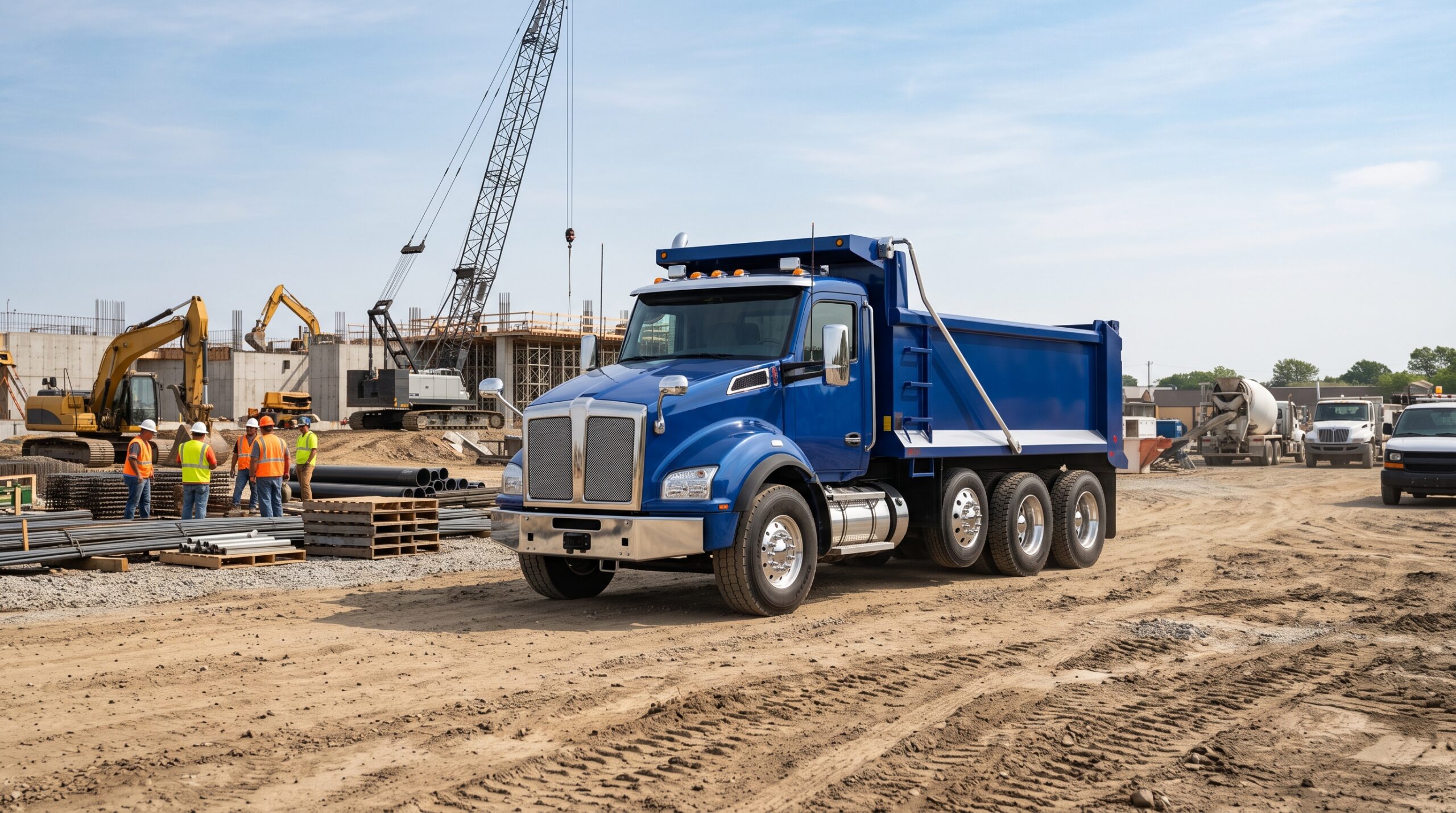
Legacy Insurance Group writes dump truck insurance for Texas haulers — tandems, single axles, transfer and end dumps, belly dumps, side dumps and demolition units — out of a Frisco office, with the same agent answering the phone every time you call. Licensed in eight states, more than twenty years in commercial transportation. If you want a real number rather than a form response, call 469-252-4001.
What Texas requires before a dump truck can run
Texas registers the carrier and files the insurance per vehicle, and the trigger is weight rather than what you haul. A truck whose gross weight, registered weight or gross weight rating is more than 26,000 pounds is a commercial motor vehicle under §548.001, and a motor carrier may not operate one on a Texas road without registering with the Texas Department of Motor Vehicles (§643.051). A one-ton dump body rated at 14,000 pounds sits outside that registration entirely — which changes your paperwork and nothing about your exposure.
Texas does not print its intrastate minimum limit in the statute. §643.101 lets the department set the required amount by rule, for each registered vehicle, capped at the federal figure, and directs it to weigh the class and size of the vehicle and what is being carried. So the number that matters is the one your registration is actually filed at. Ask what that is rather than assuming it matches the limit on your policy.
Two mechanics catch dump operators every year, and both are in §643.103:
- Evidence of insurance has to be filed with the department at initial registration, again every time you change insurers, and again on a change of ownership. Moving carriers to save premium and skipping the filing is how a legal truck quietly becomes an unregistered one.
- A copy has to ride in the cab of every registered vehicle you operate. Not the office binder — the cab.
Tow trucks are explicitly carved out of this chapter (§643.002(7)) and permitted through a different agency instead. If you run a wrecker alongside the dumps, our Texas tow truck insurance page covers that side of it.
The federal line, and whether it applies to you
The federal minimum most people have heard about is $750,000, and it is narrower than the way it usually gets quoted. Under 49 CFR 387.9, that figure applies to for-hire carriage in interstate or foreign commerce, in a vehicle rated 10,001 pounds or more, hauling nonhazardous property. Sand, gravel, dirt, aggregate, road base and demolition debris are nonhazardous property, so $750,000 is the federal floor for a for-hire dump operation that crosses a state line.
Two things follow that are worth knowing before a renewal conversation. A construction company hauling its own material across a state line is a private carrier, and private carriage of nonhazardous property is not in that schedule at all — see private carrier insurance. Being outside a filing requirement is not the same thing as being adequately insured. And most dump accounts are written at $1,000,000 anyway, because general contractors and material suppliers require it by contract, not because a regulation says so.
The coverages that decide a dump truck claim
Auto liability pays for the injury and property damage you cause other people, and it is the coverage your registration is measured against. Its two halves are bodily injury liability and property damage liability.
Physical damage covers your own truck — and on a dump, the bed, the hoist and the tailgate are a large share of what the truck is worth. A hoist cylinder is its own repair bill. Ask what value the policy carries on the body rather than the chassis alone, and if the answer is vague, a stated amount is how it gets fixed in writing.
Motor truck cargo is where dump accounts get written thin. Aggregate is cheap by the ton, so limits get set low and then tested by the one load that was not aggregate — equipment, machinery, a contractor’s material. Ask your agent two questions specifically: what the limit does on a load that is not gravel, and whether the form answers material delivered to the wrong address.
General liability covers the part of the business that is not the truck: the yard, the shop, and work performed away from the vehicle. Dumping into a driveway and cracking it is a coverage question, not a pricing one.
Medical payments covers you and anyone riding with you, and uninsured and underinsured motorist coverage answers the driver who hits your truck with nothing behind them, hit-and-run included. Rental reimbursement and downtime matters more on a dump than on most units, because the truck is out of service in the middle of a haul season and the work does not wait. If you are leased on to a carrier, non-trucking liability is what answers when you are not under dispatch.
What underwriting actually asks about a dump operation
- Operating radius, and whether the work is site-to-site or highway miles
- What you haul, and the share that is demolition debris or contaminated soil
- How much of the day is spent off-road on jobsites — uneven ground and tip-overs are priced differently from highway exposure
- Raised-bed losses: overhead lines, canopies, low bridges. It is the most repeated dump claim and the most preventable one
- Driver records, driver experience, and turnover
- Seasonality, and whether units sit idle for months at a time
Tell us the messy parts up front. A demolition share or a stretch of bad driver history is easier to place when it is in the submission than when it surfaces halfway through underwriting.
Weight, permits, and the one thing Texas does not print
Chapter 623 of the Transportation Code covers running heavy. The everyday route is §623.011, which authorises a tolerance of 10 percent over allowable axle weight and 5 percent over allowable gross, and requires the vehicle to be registered for the maximum gross weight applicable to it, not more than 80,000 pounds.
What the chapter does not contain is worth saying out loud. Texas prints a permit written specifically for ready-mixed concrete trucks (§623.0171 — three axles, $1,000 base fee, annual, windshield sticker). There is no dump-truck or aggregate-hauling equivalent in Chapter 623. A loaded dump running over legal weight is on the ordinary permit route like everyone else, and anyone quoting you a dump-specific Texas weight permit is reading something into the chapter that is not written there.
Who we write
- Sand, gravel and aggregate haulers
- Dirt and site-work contractors hauling their own material
- Demolition and debris removal
- Asphalt and road-base haulers
- Transfer, end, belly and side dump configurations
- Single-truck owner-operators — one truck, one driver, one policy is a normal account, not an exception
Where we write
We are based in Frisco and write throughout Texas. Our Texas commercial truck insurance page covers the state filings in more detail, and if your operation runs mainly out of one metro, the Houston and Laredo pages cover what is specific to those markets.
Texas dump truck insurance questions we get
What does dump truck insurance cost in Texas?
There is no honest number to put on a web page. Premium moves on your radius, the number and configuration of units, the material you haul, driver records and experience, the limits you choose, and the value carried on the bodies. Two single-truck operators in the same ZIP code can differ by double on driver records alone. We will quote it; we will not pretend to estimate it.
Do I need TxDMV registration for a one-ton dump?
If its gross weight, registered weight or rating is 26,000 pounds or less, it is not a commercial motor vehicle under §548.001 and Chapter 643 registration does not reach it. That is a paperwork answer, not an insurance one — the truck still tips, still hits things, and still needs a real liability limit behind it.
Is the bed and hoist covered, or just the chassis?
That depends on what value the policy was written at, which is why we ask for it at quote. Give us the body and hoist value separately from the chassis and the declarations page will reflect it. If you are not sure what your current policy carries, send it over and we will read it back to you.
Do I really need cargo coverage to haul gravel?
The regulations do not require it for nonhazardous property, but contracts routinely do, and the claim that shows up is rarely the gravel. It is the load that was not gravel, or a load delivered to the wrong site. Set the limit against the most valuable thing you haul in a year, not the average.
Do you have an office in Dallas or Fort Worth?
No. We have one staffed office, in Frisco, TX 75034, and we write throughout Texas from it. For commercial trucking that matters less than it sounds: submissions, loss runs, certificates and endorsements move by phone and email, and you get the same agent each time rather than whoever is nearest.
What do you need to quote it?
- Company name, DBA, and TxDMV and USDOT numbers if they have been issued
- A unit list — year, make, model, VIN, and the body and hoist value as well as the chassis
- Your operating radius and the material you haul
- Driver list with licence numbers and dates of birth
- Three years of loss runs, if you have them
- The limits you carry now, including cargo
- Whether any units are leased on to another carrier
That is enough to reach a real quote rather than an indication.
Talk to a Texas agent about your dump truck operation
Call 469-252-4001 or request a quote online.
Sources
- 49 CFR §387.9, Financial responsibility, minimum levels — Table 1, entry (1): for-hire, interstate, 10,001 lb or more, nonhazardous property, $750,000. Checked 17 September 2026.
- Texas Transportation Code Chapter 643 — §643.051 registration required, §643.101 amount set by department rule, §643.103 filing and the copy in the cab, §643.002(7) tow truck exemption.
- Texas Transportation Code §548.001 — definition of commercial motor vehicle, more than 26,000 pounds.
- Texas Transportation Code Chapter 623 — §623.011 excess axle and gross weight tolerance permit; §623.0171 ready-mixed concrete truck permit.
